VISITING A MAASAI VILLAGE IN KENYA

During our trip to Kenya, we joined a cultural visit to a Maasai community near the Maasai Mara National Reserve. The fee was €10 per person at the time, a historical price rather than current guidance. The experience felt very different from our daily lives, but describing it as a journey ‘10,000 years into the past’ would be inaccurate. The Maasai are a contemporary Indigenous people living mainly in southern Kenya and northern Tanzania. Their culture is dynamic: many families maintain pastoral traditions while also using modern technology, attending school, running businesses and participating in tourism and conservation.
Yasemin and Phaedra had already spent about two months in a Maasai community, so they did not join us. Our unusual little group consisted of two Greeks, two Turks and one German. A Maasai homestead is commonly called an enkang; ‘kraal’ is a broader term often used in English for an enclosed livestock settlement. The Maasai language is Maa. At the entrance, a group of men welcomed us with song and a jumping dance. Their bright wrapped cloth is known as a shúkà. The chief’s son lent me his and handed me a wooden club, often called a rungu. I joined the dance, rather self-consciously, and when someone jokingly asked whether the clothing and club now made me a warrior, I replied that I was only a visitor. Recognisable customs vary by community, age group and occasion, so a short tourist performance should not be taken as the complete definition of Maasai culture.
Yasemin and Phaedra had already spent about two months in a Maasai community, so they did not join us. Our unusual little group consisted of two Greeks, two Turks and one German. A Maasai homestead is commonly called an enkang; ‘kraal’ is a broader term often used in English for an enclosed livestock settlement. The Maasai language is Maa. At the entrance, a group of men welcomed us with song and a jumping dance. Their bright wrapped cloth is known as a shúkà. The chief’s son lent me his and handed me a wooden club, often called a rungu. I joined the dance, rather self-consciously, and when someone jokingly asked whether the clothing and club now made me a warrior, I replied that I was only a visitor. Recognisable customs vary by community, age group and occasion, so a short tourist performance should not be taken as the complete definition of Maasai culture.

I still wonder whether saying yes would have led to a wrestling match :) The hosts also demonstrated a traditional fire-lighting technique and then invited us into several homes in small groups. Tuğçe and I entered the same one. A small fire burned inside and something—perhaps milk—was heating above it, while Tuğçe asked about the architecture. Traditional inkajijik are compact, low-lit homes made from locally available materials; small openings help manage heat, smoke, insects and security, although designs differ. We were not offered what was cooking. Afterwards, residents showed us handmade items for sale and we returned to our friends. On visits like this, it is best to agree on the fee in advance, ask before photographing people or entering homes, and buy crafts directly from makers if you genuinely want them.
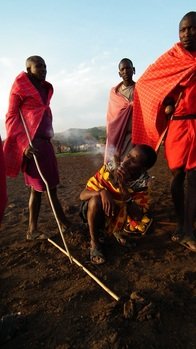
It is simply not true that Kenya has ‘no cuisine’. Kenyan food reflects many communities and histories. Indian Ocean trade, South Asian migration and British colonial rule have all influenced it, but so have long-established local traditions. Depending on the region you may encounter dishes such as ugali, sukuma wiki, nyama choma, githeri, pilau and chapati. Maasai foodways have historically centred on cattle and other livestock, especially milk and meat, while diets today vary widely.
Nor can the people we met—or Africans more broadly—be reduced to body type, diet or athletic ability. Access to water, food and healthcare varies sharply across Kenya, and pastoral communities face pressures including drought, land fragmentation and climate change. Some children waved at our vehicle and a few approached us with curiosity, but every child is an individual. Visitors should respect personal space, never touch or photograph a child without appropriate consent, and avoid turning ordinary encounters into generalisations about race or an entire continent.
In many traditional Maasai homesteads, women have played the leading role in building the houses from a framework of branches covered with a mixture that may include earth, grass and cattle dung. Homes are often arranged around a central livestock enclosure and protected by a thorn fence, helping safeguard cattle, goats and sheep at night. Interiors and settlement patterns vary; some houses include sleeping and living spaces and may shelter young animals. Buildings made from organic materials need regular repair, and pastoral mobility has historically responded to grazing and water conditions. Fixed claims that every home is 15–20 square metres, has four identical rooms or lasts exactly nine years are not reliable universal rules. Sanitation also differs from one community and project to another.
Nor can the people we met—or Africans more broadly—be reduced to body type, diet or athletic ability. Access to water, food and healthcare varies sharply across Kenya, and pastoral communities face pressures including drought, land fragmentation and climate change. Some children waved at our vehicle and a few approached us with curiosity, but every child is an individual. Visitors should respect personal space, never touch or photograph a child without appropriate consent, and avoid turning ordinary encounters into generalisations about race or an entire continent.
In many traditional Maasai homesteads, women have played the leading role in building the houses from a framework of branches covered with a mixture that may include earth, grass and cattle dung. Homes are often arranged around a central livestock enclosure and protected by a thorn fence, helping safeguard cattle, goats and sheep at night. Interiors and settlement patterns vary; some houses include sleeping and living spaces and may shelter young animals. Buildings made from organic materials need regular repair, and pastoral mobility has historically responded to grazing and water conditions. Fixed claims that every home is 15–20 square metres, has four identical rooms or lasts exactly nine years are not reliable universal rules. Sanitation also differs from one community and project to another.

Marriage customs and family structures vary across Maasai communities and are changing, so the rule we were told about taking wives from different villages should be understood as one local account rather than a universal law. Traditional Maasai spirituality centres on a supreme creator known as Enkai or Engai, associated with rain, fertility and moral order. Today many Maasai also identify as Christian, some as Muslim, and others combine religious traditions. Culture here is neither frozen in time nor simply disappearing under outside influence; Maasai people themselves continually negotiate continuity and change.
Finally, below is the video of the dance I joined during our visit. It captures one moment from a hosted cultural encounter, not an entire people. Watch it in that spirit—and, when making your own visit, choose a community-led experience that explains where visitor fees go and obtains consent for photography and filming.
With love, and wishing you good health. Factual and cultural context checked in August 2026 against Maasai Mara community-tourism information and Minority Rights Group reporting on Maasai pastoral life, land and contemporary identity.
Finally, below is the video of the dance I joined during our visit. It captures one moment from a hosted cultural encounter, not an entire people. Watch it in that spirit—and, when making your own visit, choose a community-led experience that explains where visitor fees go and obtains consent for photography and filming.
With love, and wishing you good health. Factual and cultural context checked in August 2026 against Maasai Mara community-tourism information and Minority Rights Group reporting on Maasai pastoral life, land and contemporary identity.
If You Have Upcoming Travel Plans...
When you make a purchase by clicking our links, we get to earn a small commission but you still pay the same price. So, it's a win-win for everyone!

Book hotels via Booking.com | 
Find Cheap Flights via Skyscanner | 
Get a Travel Insurance via World Nomads | 
Make International Money Transfer via Wise |

Book Tours & Attractions via Getyourguide | 
Book a Cruise | 
Book Bus/Ferry/Train/Transfer via 12goAsia | 
Find free accommodation in exchange for petsitting |