CÔTE D’AZUR VILLAGES
Updated August 2026: This article records an autumn trip made several years ago. All quoted prices, toll arrangements, restaurant details and bus numbers are historical. The former coastal route 100 and local services have been reorganised, so plan current journeys with the official Lignes d’Azur network; a standard urban trip currently starts at €1.70. The Marché Provençal and Musée Picasso in Antibes remain open, but check the city market page and museum page for seasonal hours.
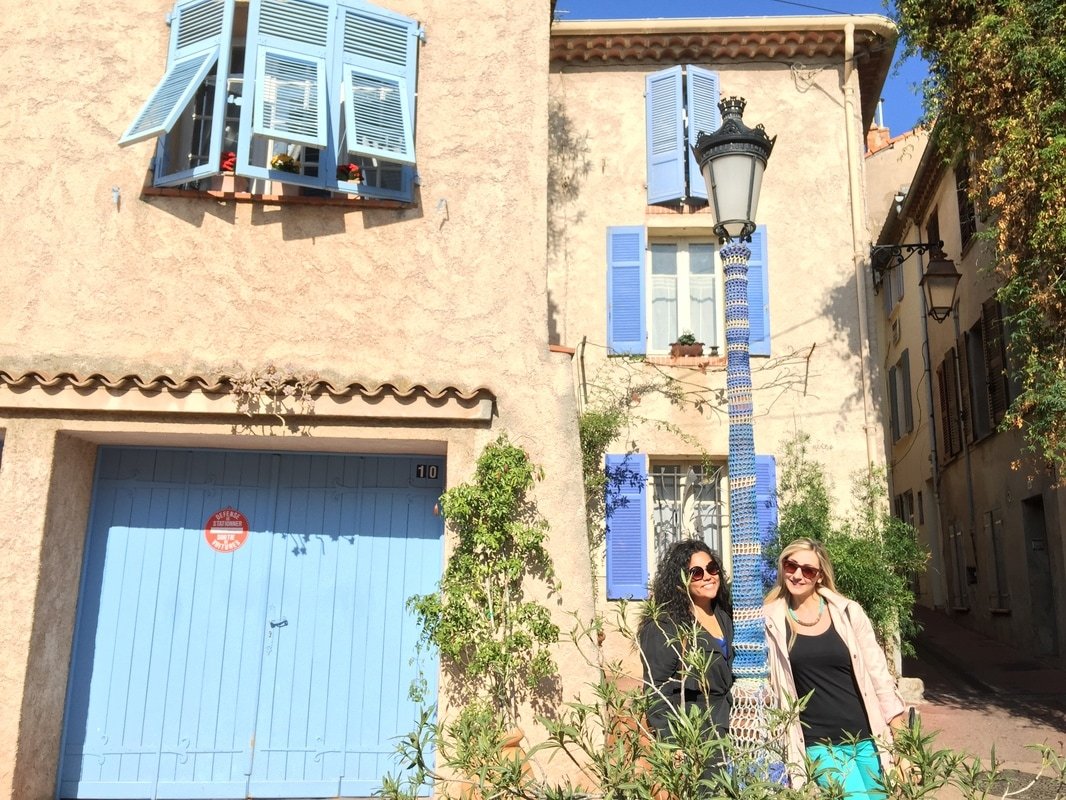
The French Riviera left us speechless when we visited at the end of October. If it could look this beautiful in autumn, with empty roads and occasional drizzle, we could hardly imagine what it must be like when the weather warms and swimming season begins. Actually, we have some idea =). For people like us, who love cities, people and a sense of life, the Côte d’Azur feels like a land of abundance where nature and urban life meet in exactly the right proportions. The food, the scenery and the pleasure of being there are enough to make you think, honestly, why couldn’t that little three-storey pink house be mine?
 |  |
The name Côte d’Azur means the azure coast, and once you are there you may find yourself staring at the water as if hypnotised. Our light-coloured eyes make us so sensitive to sunlight that we normally insist on sunglasses at the slightest brightness, yet for the first time we sat on a bench saying, ‘I want to see this beauty with my own eyes.’ Travellers who have seen turquoise tropical seas and the green of tea plantations may disagree. But add straw-hatted gentlemen, elegant French women and a simple glass of white wine at a table overlooking the sea, its scent mingling with perfume, and the calm suddenly becomes pure pleasure. Simplicity, wealth and beauty together create the spirit of the French Riviera.
 |  |  |
Among the Côte d’Azur’s highlights are its famous hilltop and seaside villages. We visited many of them. The easiest plan is to stay in a larger city such as Cannes or Nice and rent a car, though local buses can also be an inexpensive and sensible option if you watch the timetables. We explored some villages by car from Cannes and others by bus from Nice. They included Grasse, famous for perfume and familiar to Turkish viewers from the series Gecenin Kraliçesi; Èze, a TripAdvisor favourite; and Saint-Paul-de-Vence, the most storybook-like of them all. Yet our own favourite was Saint-Jean-Cap-Ferrat, which appeared almost by surprise. Details below.
ÈZE
Every French Riviera guide seems to list Èze among the essential places to visit. Many villages in this region also have a seaside counterpart, so do not confuse Èze village with Èze-sur-Mer. If, like us, you arrive by bus or car, you will notice just how steeply the road climbs. Our bus climbed so high that for a moment we thought we had risen above the clouds =).
 |  |  |
The village itself has no single spectacular attraction, but combine tasteful old stone houses, autumn leaves and an endless sea view from the hilltop and the result is irresistible. It is ideal for a relaxed, lovely day. If money is no object, the two-Michelin-starred La Chèvre d’Or awaits, though as visitors joke, your heart may not survive the bill =D.
 |  |
Èze is known for expensive art galleries and wonderfully cute gourmet restaurants tucked into every corner. Our suggestion is to wander through the village, stop for coffee and save your appetite for the tiny pizzeria in Cap-Ferrat. We visited on a rainy day, and the autumn colours suited Èze beautifully. We could not stop taking photographs.

Another famous feature is the Nietzsche Path, a rough trail descending from Èze village to the coast. Nietzsche is said to have walked here every day while working on Thus Spoke Zarathustra. We intended to take the path down, but it can be dangerous in wet weather, so we chose the bus instead. At the time, bus 83 took us to the coast. If you walk the trail, wear proper walking shoes.
 Even Èze’s fountains are works of art. |  The Nietzsche Path starts here. |
For the full sightseeing package, there is also the Jardin Exotique at the top of the village, though we found admission expensive. We preferred to rest over coffee in a sweet village café and enjoy the view from there. We like to travel slowly rather than treating places as a checklist, so our default state is usually coffee in hand, watching the view and the people passing by =). The coffee was strong, exactly as we like it, and cost €3 at the time.
 The café where we watched the rain instead of dining at La Chèvre d’Or. |  Our view from the café. |
At the time of our visit, bus 82 ran from Nice’s Vauban bus station to Èze village. A single ticket cost €1.50, while a ten-journey pack bought from a tourist-information office cost €10.
 A sculpture in the garden of La Chèvre d’Or. |  Sculptures like this appear all around Èze. |
SAINT-JEAN-CAP-FERRAT
After half a day in Èze, we took bus 83 down to the coast and jumped off when we spotted a marina. It turned out to be Beaulieu Marina, the starting point of one of the most beautiful seaside walks on the Côte d’Azur. We took a few photographs and later learned that this apparently unassuming resort town enjoys one of the finest microclimates on the entire Riviera. Even Gustave Eiffel and Gordon Bennett once holidayed here.
 Beaulieu Marina |  A hotel at the beginning of the road to Cap-Ferrat. |
Since we had already left the bus, we decided to walk and discovered the pedestrian-only Promenade Maurice Rouvier along the sea. It became our favourite part of the entire trip. Despite the cool, rainy weather, we fell in love with the colour and scent of the water. We perched on a bench and imagined that one of the houses belonged to us. We were not the only ones to adore it: this magnificent 1880s villa once belonged to Charlie Chaplin and later to Hollywood actor David Niven. Who knows—perhaps one day it will be ours =).
 Like a fairy tale, even beneath grey skies. |  The house we fell in love with =) |
At the end of this easy but enchanting 1.8-km walk, you reach Saint-Jean-Cap-Ferrat. Here you can genuinely say that the journey matters more than the destination. Cap-Ferrat itself is a familiar sort of resort town with a marina.
 The rear view of Chaplin’s former home. |   That wonderful pizza. |
Several restaurants and cafés around the marina and village square were open. We chose a tiny pizza counter we had noticed along the way. From the wonderfully unhurried owner of Little Italy Pizzeria, we could already tell the pizza would be good. The €10 Sicilian pizza, with melting cheese and flavourful cherry tomatoes, became a feast beneath a lush green arbour overlooking the marina.
 The square in Saint-Jean-Cap-Ferrat. |  Our view from the stop where we waited for the bus to Nice. |
VILLEFRANCHE-SUR-MER
Since we had come this far, we waited ten minutes at a storybook bus stop in Saint-Jean-Cap-Ferrat, boarded the number 100 toward Nice and stopped in Villefranche-sur-Mer on the way. It was off-season and getting late, so we stayed for only an hour.

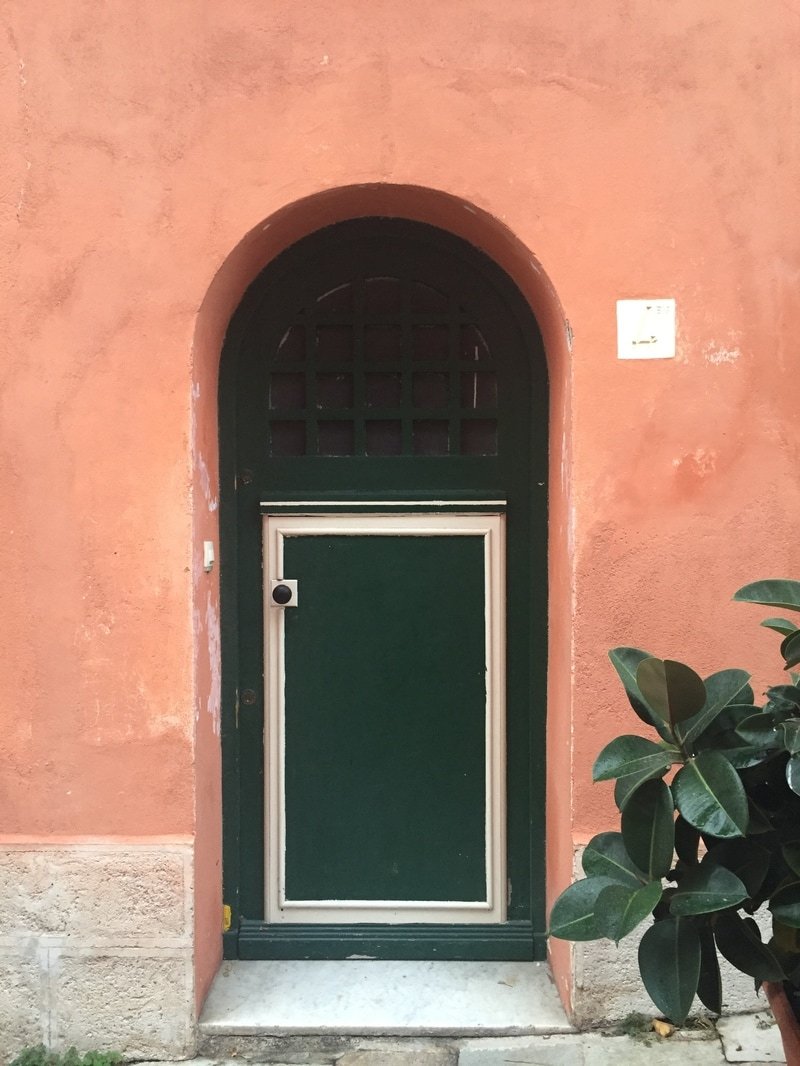
With its lovely marina and rows of colourful apartment buildings, Villefranche is a beautiful seaside town. Step into the old centre, though, and it becomes thoroughly medieval. Some lanes are extremely narrow, passing through tunnels beneath the buildings. The old yellow lamps glowing in the dark, damp passageways somehow made me think of a scene from Les Misérables.
 |  |  |
After a walk along the waterfront, we caught sight of the deep-blue sea and boats framed between two terracotta-coloured buildings and drifted into daydreams again. What would life be like if we were the family eating together on that balcony? Nice has a very pebbly beach, so Villefranche’s Plage des Marinières is especially popular in summer. Like many settlements on the Riviera, the town also has a medieval citadel with views worth seeing.
 |  |
GRASSE
We drove from Cannes to Grasse for the day. Perched high on a hill, it is the heart of the Côte d’Azur perfume industry. Our guides, Burcu and her husband, could not understand the fuss—and yes, it may not be spectacular—but we liked Grasse too. The hill views from the square and garden near the entrance were especially lovely, while colourful buildings and palm trees created a warm atmosphere.
 |  |
If you visit Grasse, you can explore the famous perfumeries Fragonard, Molinard and Galimard. We chose the Fragonard museum and perfumery just beside the square. They also sold beautifully scented olive-oil soaps, though as Aegeans we are already very familiar with products like these.
 Fragonard Perfume Museum |  After leaving the museum, take the street on the right into old Grasse. |
The historic streets are wonderful for walking and photography. For something a little more playful, you can take the yellow petit train. No matter how much I insisted, my travel companions failed to see its brilliance and refused to pay €10 each for a village that takes twenty minutes to cross on foot. Naturally, that did not stop me posing for a photograph.
 The petit train and me =) |  A view from the park in Grasse. |
If you continue from here toward Digne, remember to take the Route Napoléon, said to be one of Europe’s most enjoyable driving roads. Since we came from Cannes, we saw only its beginning. If you drive around the Côte d’Azur, you will inevitably meet the A8 motorway. At the time we carried plenty of coins and carefully chose the cash lane at toll booths; more than once we ended up in the wrong lane and held up the traffic.
 |  |  |
SAINT-PAUL-DE-VENCE
This was the most characterful village we visited on the entire French Riviera: elderly men playing pétanque, sweeping views, beautifully designed gardens, elegant and expensive art galleries, narrow stone lanes and historic fountains. You can tick every box. We recommend putting this hilltop village near the top of your Côte d’Azur list.
 Pétanque, one of the symbols of southern France. |  We loved this olive-tree artwork. |
Once again, we drove here from Cannes. Cars cannot enter the village, but there is a large car park at the entrance. By pure luck we visited on a Sunday, when parking was free at the time. At the entrance stands the world-famous Michelin-starred La Colombe d’Or. We had hoped to stop for at least a coffee, but unfortunately the restaurant was closed. In the 20th century, artists including Matisse, Picasso and Marc Chagall used to dine here.
 La Colombe d’Or |  The band playing in the rain while we drank coffee. |
With La Colombe d’Or closed, we sat opposite at Café de la Place, with its high ceiling and marble bar. We drank hot coffee while watching a band play outside in the rain. We loved the atmosphere and would recommend sitting here simply to watch the square.
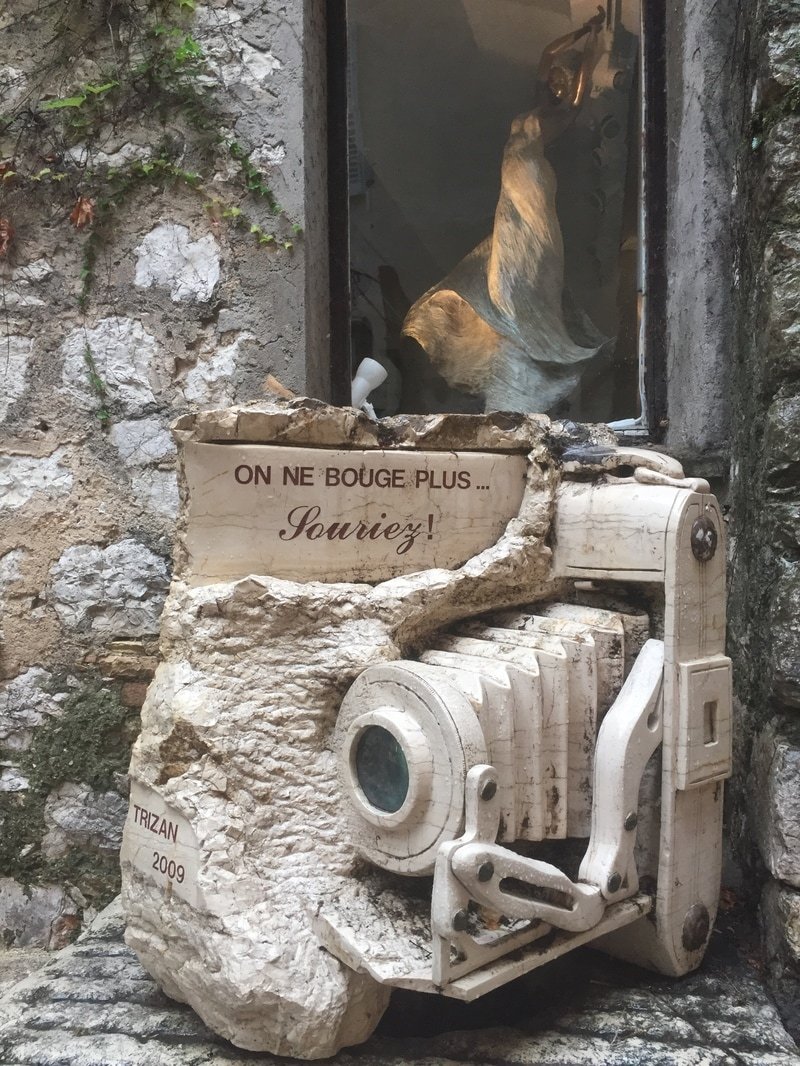 | 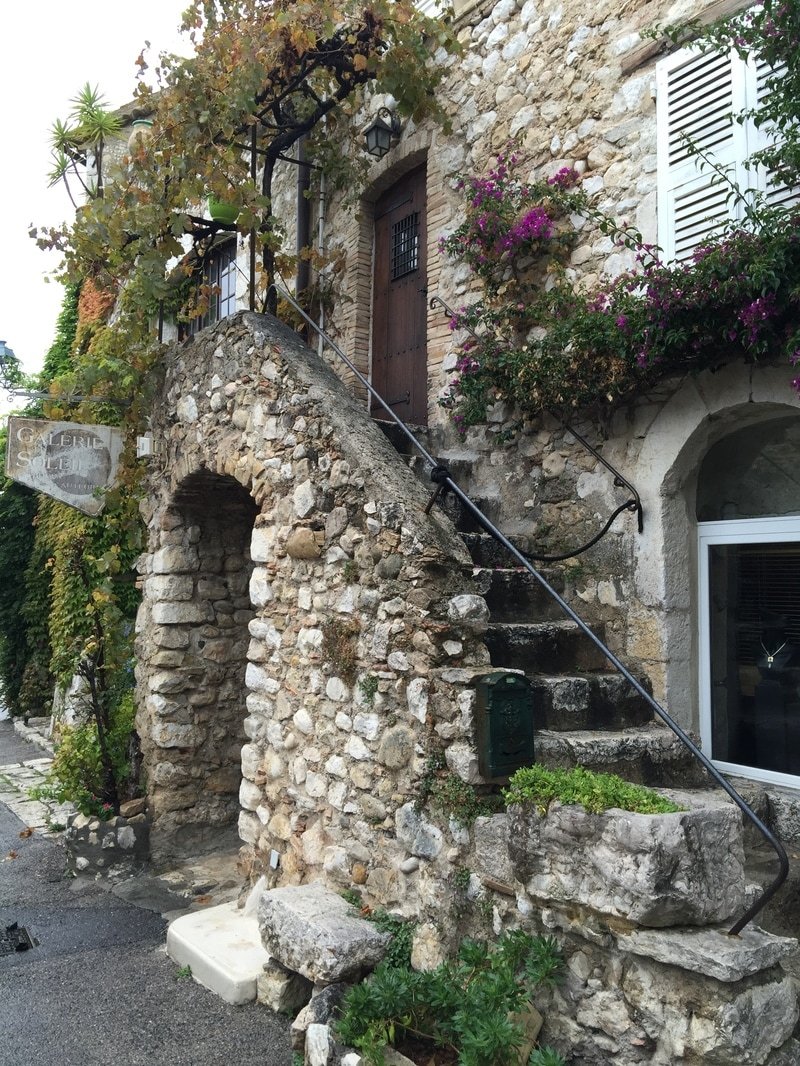 |  |
After coffee, we entered the village and wandered its narrow stone lanes, sheltering from the rain and looking into gallery windows. Autumn had worked its magic again: stone walls draped in red leaves looked like a film set. Follow Rue Grande and you will see almost everything while walking from one end of the village to the other. Despite its name, the street is extremely narrow; we cannot imagine it in high season.
 |  |
At the end of Rue Grande, look down from the walls over the beautiful cypress-covered hills of the Côte d’Azur. Pass through Porte de Nice just beyond the village and you will find a romantic cemetery. On a rainy day, perhaps you might leave a rose on Chagall’s grave.
 Autumn suits it so well. |  The cemetery at the end of the road, where Chagall is buried. |
After visiting the cemetery, return along the same route or follow the narrow cobbled path outside the walls back toward the village entrance. The reward of the outer path is the view over the magnificent landscape below.
ANTIBES
We discovered Antibes by chance while driving from Cannes toward Monaco, liked it immediately and parked the car. We enjoyed it so much that we later returned. The waterfront path, blue sea and sunshine make for a deeply peaceful walk. We bought a fresh baguette, French cheese and ham from a grocery shop and had a little picnic.
 A sunny autumn morning =) |  The old town seen from the waterfront. |
Picasso lived here for a time, and the place where he worked is now the Musée Picasso. Do not miss it if you are interested. We walked along the seafront ramparts into the old centre and visited the Marché Provençal, which at the time sold fresh food every morning except Monday. On Friday nights, a basement beneath a soap shop in the market housed Absinthe Bar La Balade, where you could drink absinthe with piano music for €4.
 |  |
The public beaches are said to be very popular in summer. We were there in October and did not swim, though the colour of the water was beautiful. After coffee in the lanes of the old town, we continued on our way. You will almost certainly pass Antibes while exploring the Côte d’Azur, so we recommend spending at least an hour by the sea.
 |  |
If You Have Upcoming Travel Plans...
When you make a purchase by clicking our links, we get to earn a small commission but you still pay the same price. So, it's a win-win for everyone!

Book hotels via Booking.com | 
Find Cheap Flights via Skyscanner | 
Get a Travel Insurance via World Nomads | 
Make International Money Transfer via Wise |

Book Tours & Attractions via Getyourguide | 
Book a Cruise | 
Book Bus/Ferry/Train/Transfer via 12goAsia | 
Find free accommodation in exchange for petsitting |