Maasai Mara
Practical update (August 2026): This article describes our original trip. Park and conservancy fees, road conditions and migration timing change by season. Current guidance lists reserve or conservancy charges separately, often around US$100–120 per adult per night, while the Great Migration usually reaches the Mara from late July or early August. Check the latest terms with your camp or safari operator before booking.
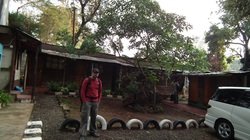
After one night in Nairobi, our safari vehicle and our dear driver Jimmy collected us from Milimani Backpackers early the next morning. Our cook came too; on this kind of safari, the tour often includes someone to prepare meals along the way. The hostel was central, inexpensive and secure, although the staff were not exactly cheerful. By seven, our bags were loaded, we had exchanged money for Kenyan shillings, and after our first rather shocking encounter with the public toilets beneath Nairobi City Hall, we were on the road.
Jimmy was Kikuyu, so we listened to Kikuyu gospel music as the city faded behind us. At lunch we stopped at a small roadside restaurant and, not yet knowing that we would eat a similar meal almost every day, tucked into rice, chicken, boiled greens and chapati. Chapati is a simple flour-and-water flatbread, rather like Turkish gözleme without a filling, and it is eaten with almost every meal. I actually loved it. Half an hour later came our first reminder that nothing in Africa necessarily goes to plan: the final 90 kilometres to Maasai Mara had no asphalt. We bounced along the muddy road in the rain, occasionally wondering whether we might tip over, and eventually reached our camp just outside the reserve. We dropped our bags in the tents and immediately headed out on our first game drive.
Jimmy was Kikuyu, so we listened to Kikuyu gospel music as the city faded behind us. At lunch we stopped at a small roadside restaurant and, not yet knowing that we would eat a similar meal almost every day, tucked into rice, chicken, boiled greens and chapati. Chapati is a simple flour-and-water flatbread, rather like Turkish gözleme without a filling, and it is eaten with almost every meal. I actually loved it. Half an hour later came our first reminder that nothing in Africa necessarily goes to plan: the final 90 kilometres to Maasai Mara had no asphalt. We bounced along the muddy road in the rain, occasionally wondering whether we might tip over, and eventually reached our camp just outside the reserve. We dropped our bags in the tents and immediately headed out on our first game drive.

Maasai Mara is a vast reserve roughly 250 kilometres from Nairobi in south-western Kenya. Covering about 1,500 square kilometres, it forms the northern Kenyan part of the much larger Mara–Serengeti ecosystem, which extends into Tanzania.
In the Maa language, Mara means “spotted”, a reference to the way trees, clouds and savannah appear as dots across the landscape. The reserve supports an extraordinary range of wildlife and is especially famous for its big cats. Facts aside, the feeling of being there is unlike anything else. Watching animals simply exist in their own world makes work, water bills and the sofa you were thinking of buying feel as if they belong to a completely different reality.
In the Maa language, Mara means “spotted”, a reference to the way trees, clouds and savannah appear as dots across the landscape. The reserve supports an extraordinary range of wildlife and is especially famous for its big cats. Facts aside, the feeling of being there is unlike anything else. Watching animals simply exist in their own world makes work, water bills and the sofa you were thinking of buying feel as if they belong to a completely different reality.

We entered the reserve on three consecutive days and enjoyed every visit. If you come to Kenya, you naturally start looking for the Big Five: lion, buffalo, leopard, elephant and rhinoceros. The name comes from the difficulty and danger hunters associated with these animals, not their size. For us, the leopard was by far the hardest to spot. Gazelles and zebras dazzled us from the moment we entered; there were so many that, after a while, they almost felt like familiar neighbours. We were told that zebra foals recognise their mothers by their stripe patterns. Research on whether stripes cool zebras is still debated, so it is better treated as an interesting theory than a settled fact.

If we counted correctly, we saw thirteen lions. The most dramatic scene was a lion feeding on a buffalo beside the vehicle track. He looked every inch the king of the savannah—although learning that lionesses usually do most of the hunting dented the image a little. Vultures waited cautiously at a distance while jackals ran around hoping for a chance. When we tell this story, people ask whether we were afraid of an attack, but the animals were not interested in us and leaving the vehicle was strictly forbidden. We were warned to keep our distance from elephants. Most of us have seen an elephant in a zoo, but on an open plain its scale is astonishing; next to a zebra it looked enormous.

We saw leopards only twice, almost as silhouettes: once while one was trying to haul an impala into a tree, and once far away with cubs. Even that, we were told, was lucky. Buffalo moved in herds, often accompanied by small birds. Buffalo already have a slightly comic expression, and the bird perched on top completed the picture.
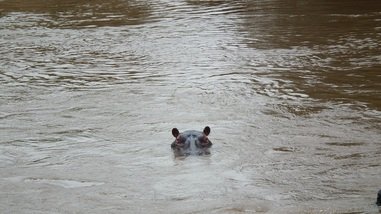
Then there were the giraffes, perhaps the most endearing animals in the reserve. They seemed unaware of their own height and would half-hide behind the nearest bush, peering over it with those extraordinary eyelashes. Wildebeest fascinated us too, though their grumpy, goat-like faces reminded me of the old men in The Muppet Show. My personal favourites were the zebras; their patterns remained hypnotic no matter how many we saw. We also reached the Mara River, where it took us ten minutes to notice a crocodile camouflaged in the mud. Hippo families looked comical in the water, although hippos are among Africa’s most dangerous large animals. We visited in late September. Migration timing is driven by rainfall and varies from year to year, so our expectation that it would arrive a week or two later was only a local estimate—and we did not see the main crossing.
Then there were the giraffes, perhaps the most endearing animals in the reserve. They seemed unaware of their own height and would half-hide behind the nearest bush, peering over it with those extraordinary eyelashes. Wildebeest fascinated us too, though their grumpy, goat-like faces reminded me of the old men in The Muppet Show. My personal favourites were the zebras; their patterns remained hypnotic no matter how many we saw. We also reached the Mara River, where it took us ten minutes to notice a crocodile camouflaged in the mud. Hippo families looked comical in the water, although hippos are among Africa’s most dangerous large animals. We visited in late September. Migration timing is driven by rainfall and varies from year to year, so our expectation that it would arrive a week or two later was only a local estimate—and we did not see the main crossing.
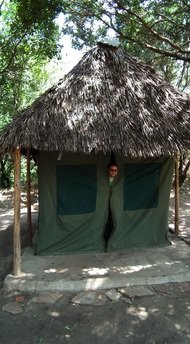
Our camp in Maasai Mara was memorable too. The tent stood on a raised base and was remarkably comfortable for the conditions, with beds, a toilet and a shower. A roof woven from branches and covered with palm leaves sheltered the tent.
Maasai villages are also found in this region. We visited one, but that experience deserves its own article. After Maasai Mara, we understood why the animals in nature documentaries have exactly those colours: against the savannah they almost disappear. The light, scale and palette are extraordinary. In one sentence, experiencing Maasai Mara feels like the world reminding you that it is still there.
From here we returned to the road and travelled west towards Lake Naivasha.
Maasai villages are also found in this region. We visited one, but that experience deserves its own article. After Maasai Mara, we understood why the animals in nature documentaries have exactly those colours: against the savannah they almost disappear. The light, scale and palette are extraordinary. In one sentence, experiencing Maasai Mara feels like the world reminding you that it is still there.
From here we returned to the road and travelled west towards Lake Naivasha.
If You Have Upcoming Travel Plans...
When you make a purchase by clicking our links, we get to earn a small commission but you still pay the same price. So, it's a win-win for everyone!

Book hotels via Booking.com | 
Find Cheap Flights via Skyscanner | 
Get a Travel Insurance via World Nomads | 
Make International Money Transfer via Wise |

Book Tours & Attractions via Getyourguide | 
Book a Cruise | 
Book Bus/Ferry/Train/Transfer via 12goAsia | 
Find free accommodation in exchange for petsitting |