SIEM REAP
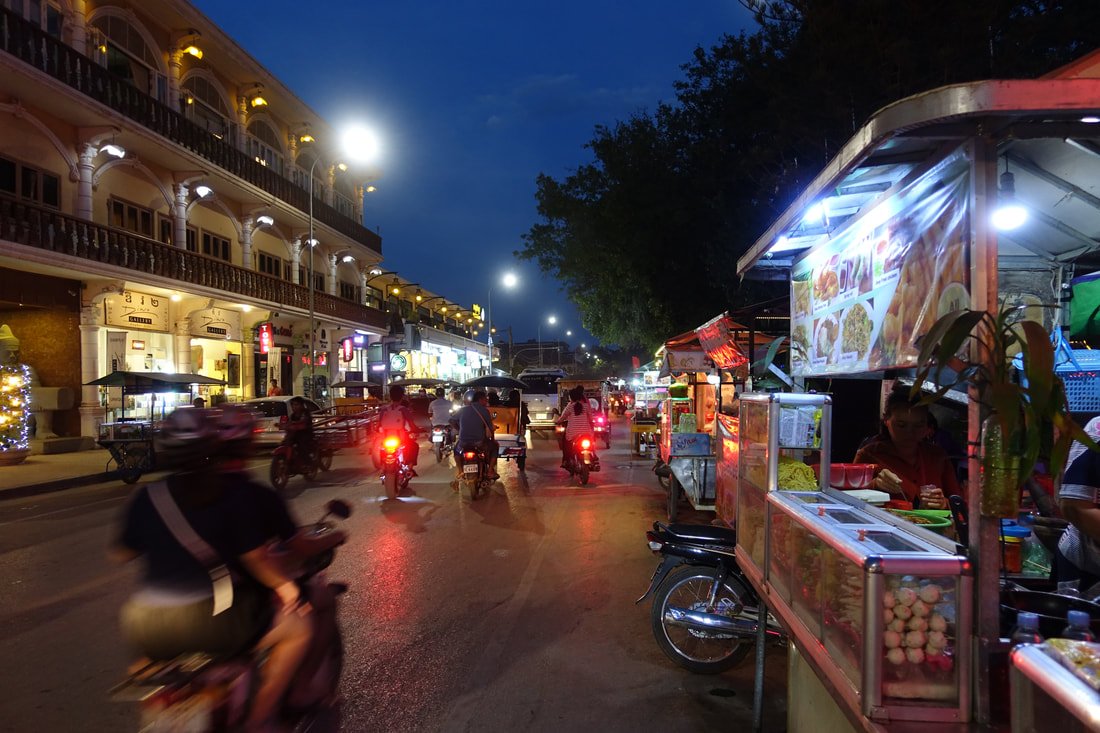
Siem Reap is a small, brightly lit city in northern Cambodia, famous for Angkor Wat. It is chaotic but still rather charming, with busy bar streets, restaurants and night markets whose exact number we still have not managed to figure out. We read that its expat population is also quite large. Most people spend three or four days here, visiting Angkor Wat in the mornings and heading to the bars at night. To be honest, they are not making a bad choice, because the city is a little dead during the day.

| 
|
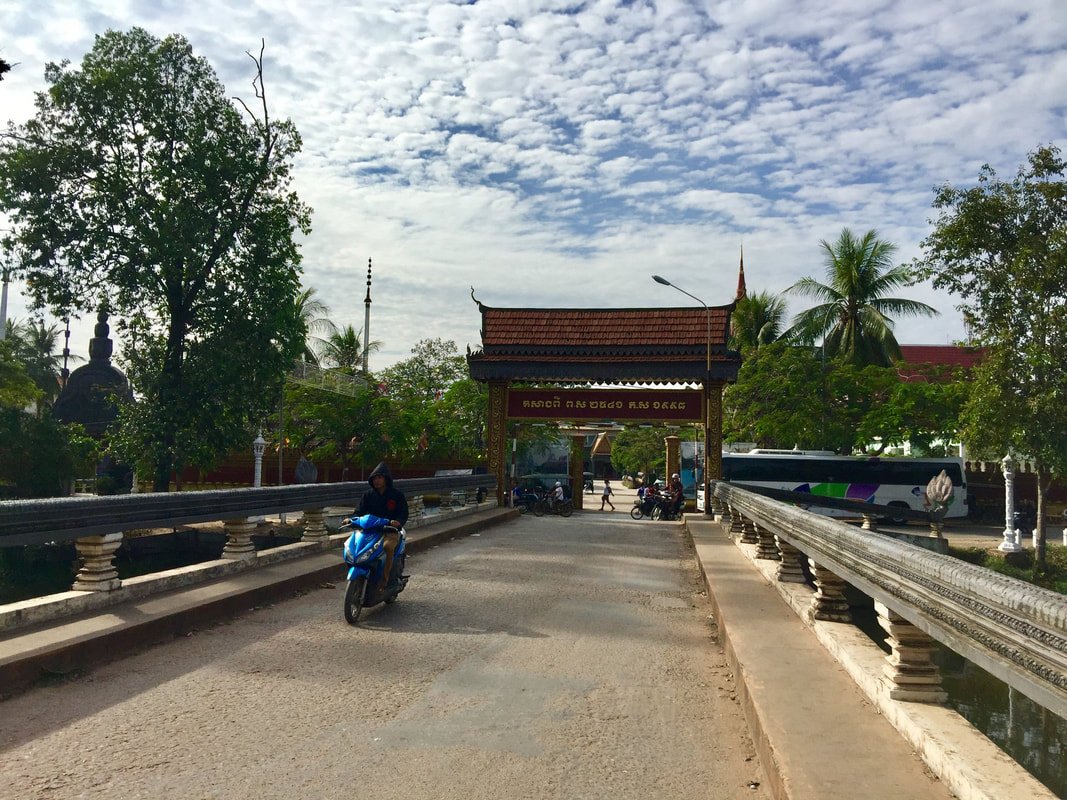
Before we went, we had read that Cambodia had something of a rubbish and dust problem. Still, to be honest, even though we live in Asia, the chaos of the city surprised us. Since it is immediately obvious that you are a foreigner, tuk-tuks stop you on every street, rubbish piles up along the roads, music rises from every venue, and dust and exhaust fumes become your closest companions. Despite all this, Siem Reap became our favourite city in Cambodia. With its cool boutique hotels bursting through the greenery, lively cafés with tables spilling onto the streets and peaceful riverside, it is an attractive city that deserves at least one day of your time beyond Angkor Wat.

| 
|
Actually, for New Year’s, we had sworn not to leave the house, let alone travel abroad, but AirAsia made us break that promise. When we found a flight from Kuala Lumpur to Siem Reap for 120 TL, we were already in Siem Reap on the morning of 31 December. January is considered an ideal month to visit Cambodia, Laos and Vietnam, as it is Cambodia’s dry season and the weather is spring-like. The weather really was wonderful when we stepped off the plane: the oppressive humidity of Malaysia was gone and it was a perfect 27°C.

| 
| 
|
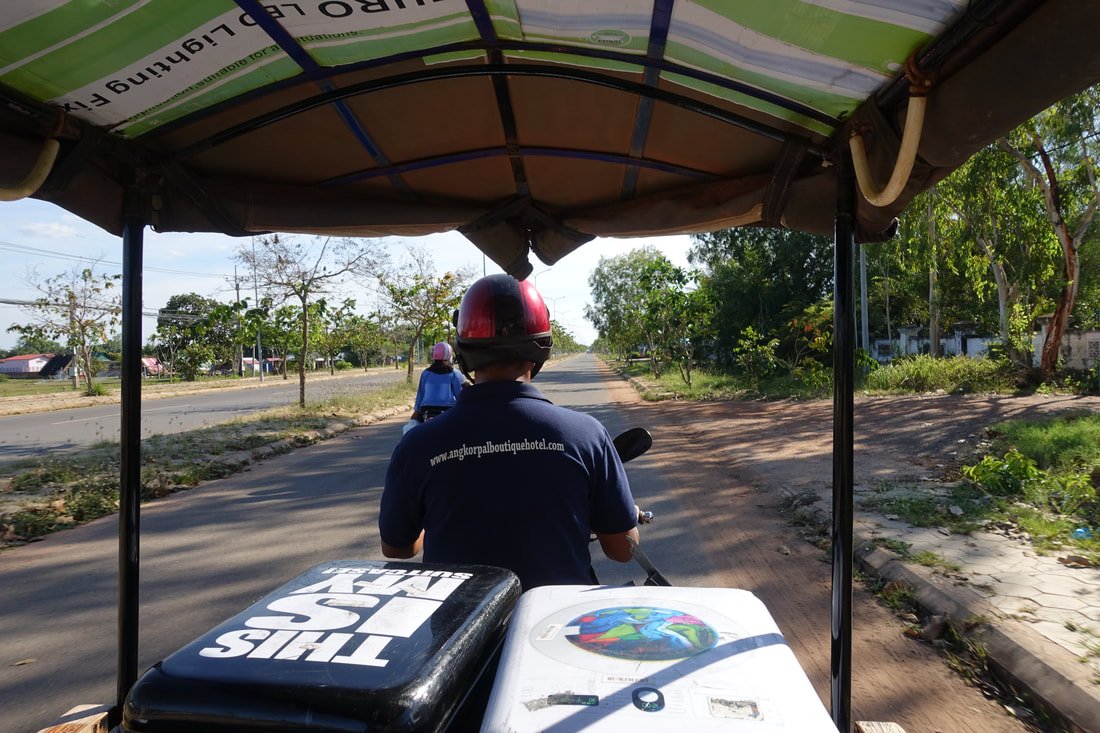
Getting from Siem Reap Airport to the city centre is relatively easy because, when you arrive, your hotel will usually send a tuk-tuk to pick you up as part of the room rate. If they do not, email them in advance and ask them to do so, because the drivers swarm around you like vultures as soon as you leave the airport. Our tuk-tuk driver was a little late, so we immediately bought a SIM card with 15 days of unlimited internet from the Metfone shop at the airport exit for 6 dollars. Cambodian tourist SIM cards do not allow you to share your phone’s internet connection, but we found a way around that in five minutes. We then jumped into our tuk-tuk, reached our airy hotel and spent the rest of the day lazing beside its very “Instagrammable” pool until nightfall.

| 
|
NEW YEAR’S EVE IN SIEM REAP
Because we had made an international journey and genuinely do not like New Year’s celebrations, we took a quick tour of the city that evening, sampled some street food, had a coffee and returned to our hotel around 10:30 pm. We welcomed the New Year quietly with tea by the pool, accompanied by colourful fireworks being launched all over the city.

| 
|
Although the bars and shops outside were packed, people were not going quite as wild as we had expected. It was New Year’s Eve, after all, and we had anticipated a little madness. Alcohol is extremely cheap in Cambodia, and there are countless “happy pizza” shops on every corner. As you can probably guess, these pizzas are made with weed. We were told that Cambodian law says “you cannot smoke marijuana” but does not say “you cannot eat it”, so people started making and selling food with cannabis.
PLACES TO VISIT IN SIEM REAP
ANGKOR WAT

These magnificent temples, added to the UNESCO World Heritage List in 1992, are already the sole reason most people come to Cambodia. Angkor Wat you can read our Angkor Wat article here.

| 
|
ANGKOR NIGHT MARKET
As you know, Asian night markets are famous around the world, and Siem Reap is no exception. As soon as the sun goes down, stalls appear and colourful bulbs light up the streets. In fact, the entire city turns into one huge night market, but this is one of the best-known streets, with a large Angkor Night Market sign at its entrance.

| 
|
These night markets have just about everything: breezy beach dresses, traditional Thai trousers, souvenirs, key rings, authentic bowls made by painting coconut shells with mother-of-pearl, and much more. I bought myself a giraffe T-shirt for 1 dollar and a wonderful pair of Thai trousers for 5 dollars, while Gökay bought several T-shirts with Angkor Wat designs. Bargaining is essential here. Usually, you name one-third of the first price and eventually settle at around half.

| 
|
You can find plenty of opportunities here not only to buy things, but also to sample street food or have a massage. Massage chairs are set up on pavements and streets, so you can have your feet, back or neck massaged while watching people go by. Cambodian massage parlours are just as common and affordable as Thai massage parlours.

| 
|
SOK SAN ROAD
Sok San Road is one of the most colourful and longest streets in Siem Reap. It is close to Pub Street and is a popular place to stay. We chose to stay here too, which made everything much easier because of its central location. We were on a busy street close to everything, but still a little way from the most crowded lanes.

| 
|
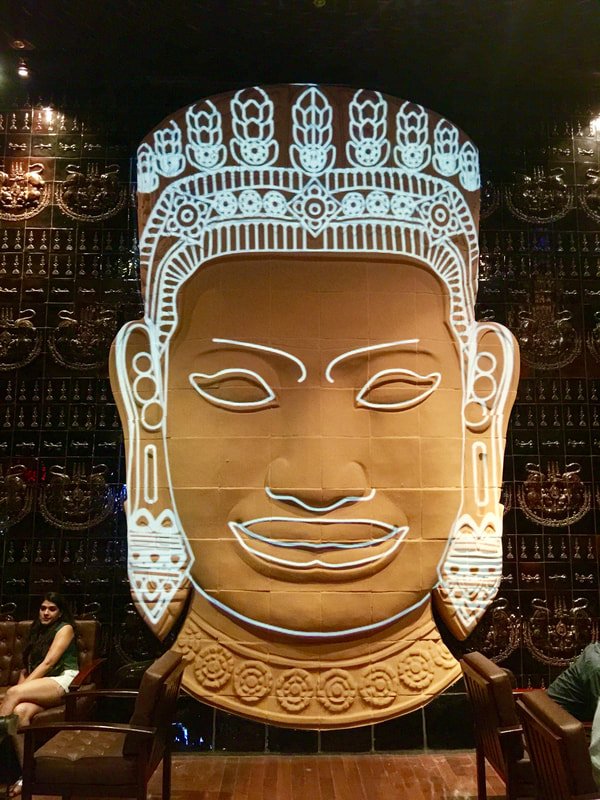
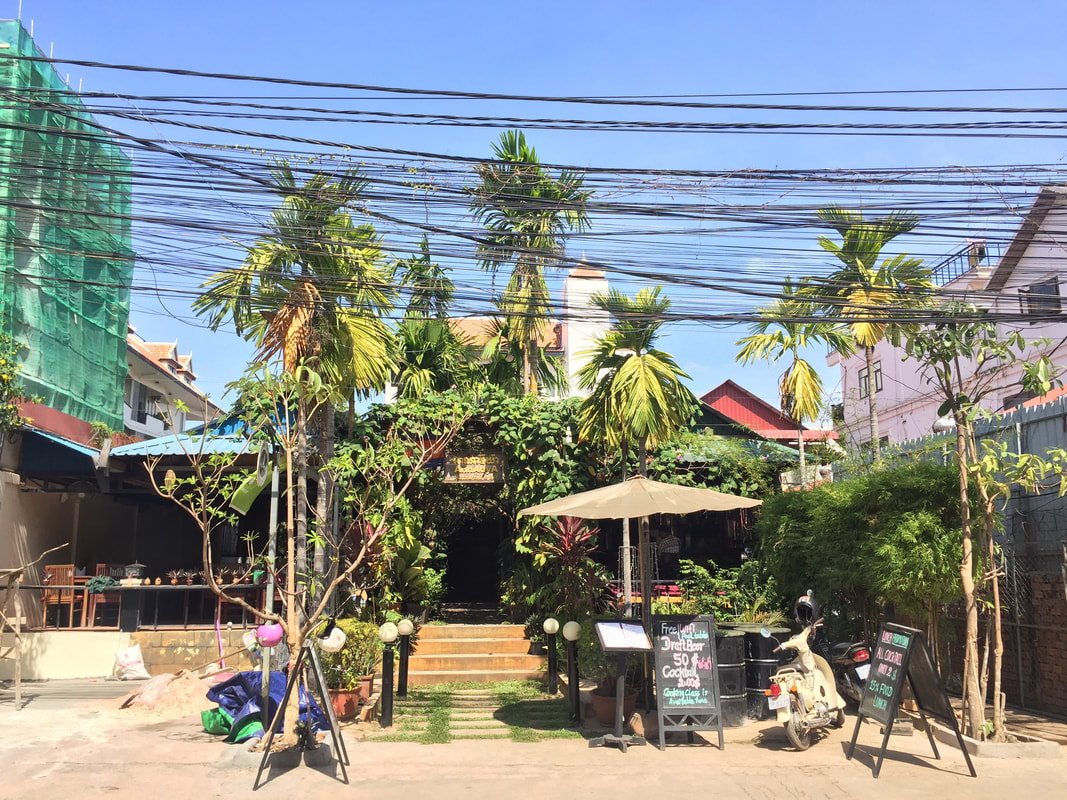
One of Siem Reap’s coolest bars is here too: Soul Kitchen. There is live music once a week, and otherwise you can try delicious cocktails while watching people pass by. Inside, there is a huge Buddha statue with projections mapped onto it, which really caught our attention. We kept going over to photograph it until the owner finally came over and said, “Why don’t you sit down today?” =)
| 
|
We also found Siem Reap’s cheapest massage parlour on this street. Lady 1 Massage is not especially attractive, but it is reasonably clean and stays open late. A one-hour foot massage costs 3 dollars, or 4 dollars if you want the massage to go up to your knees. An hour-long foot massage in an air-conditioned room with Wi-Fi feels like medicine after a tiring day of travel. Massage prices in Siem Reap are also much cheaper than in Phnom Penh and on the islands.


| 
|
PUB STREET
This street is dead during the day, but at night it comes alive with deafening music and even flaming street kitchens. We generally do not enjoy this kind of entertainment much, so we preferred to walk through the street from end to end every now and then.

| 
|
WAT PREAH PROM RATH
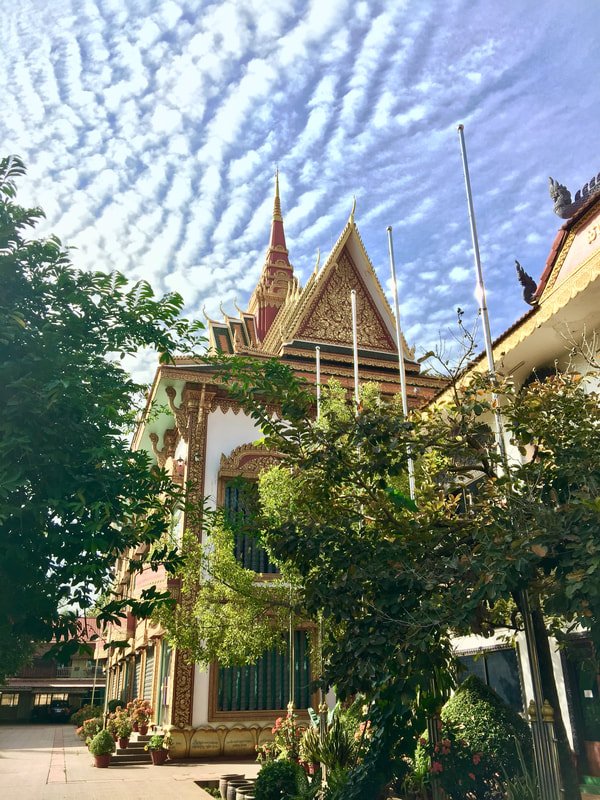
This modern temple pulled us right in while we were walking along the river. It has a peaceful garden beneath a deep blue sky. Its decorated pagodas sparkle in the sun, while the euonymus bushes trimmed into elephant shapes are unbelievably cute.

| 
| 
|
According to legend, in the 1500s a monk travelled here from near Phnom Penh. Whenever he came, he brought a fresh bowl of rice with him. One day, while travelling by boat, a shark attack split his boat in two, but he still managed to reach this place safely in half a boat. In his memory, a reclining Buddha statue was made from that half of the boat.
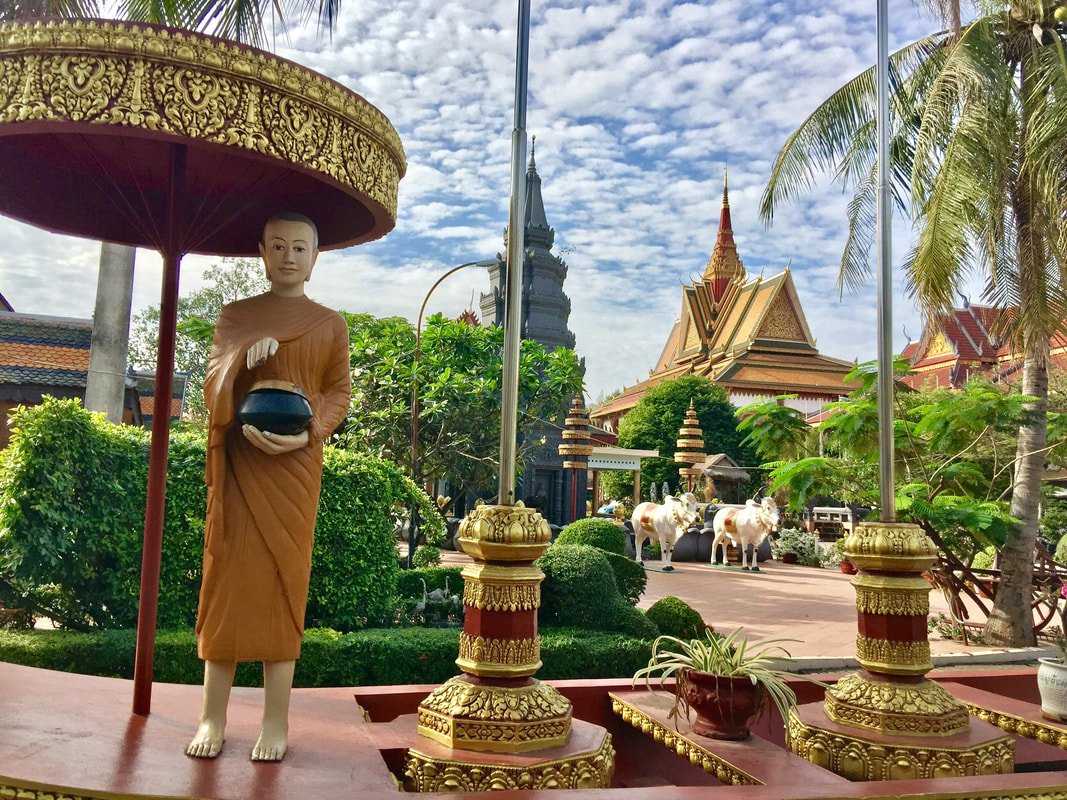
As you can see, our monk is holding a freshly filled bowl of rice.
PSAR CHAS OLD MARKET
This historic market between 9th Street and Hospital Road sells fruit and vegetables, trinkets and tourist odds and ends. To be honest, we only took photographs and marvelled at how Cambodian women could sit on the stalls where they were selling things all day long. We heard that silver is very affordable in Cambodia, but we did not look into it because we know little about these things and thought we would be likely to get overcharged.

| 
|
WAT BO ROAD
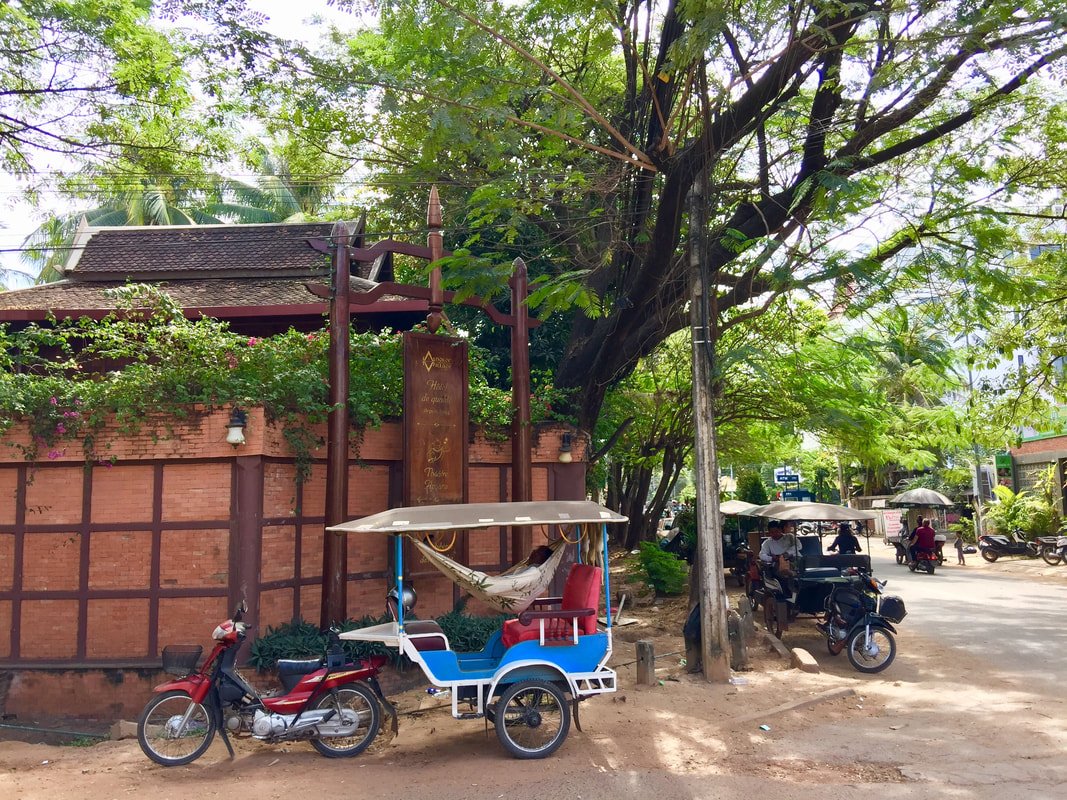
We had read that this broad Siem Reap street was lined with new and very trendy cafés and restaurants. We did come across one or two, but there is also a great deal of traffic here, so the dust and exhaust fumes are intense.
| 
|
RIVERSIDE
Although nobody seemed to use this riverside, it is a pleasant place for an evening walk. We loved Cambodia’s January weather and found it very peaceful because tuk-tuk drivers did not swarm us while we walked. At night, the bridges over the river are decorated with colourful lights.


| 

|
KING'S ROAD ANGKOR
This small shopping area feels like a rescued corner very close to Siem Reap’s chaotic city centre. Cross the river after leaving Psar Chas and you will find it behind Hard Rock Cafe. Most of the things sold here are made or designed in Cambodia. What made us happiest, though, was having a delicious coffee at Rohatt Cafe, perhaps Siem Reap’s prettiest café, surrounded by greenery and away from the noise of cars.


| 
|
There is also a lovely branch of Cambodia’s famous Blue Pumpkin café chain right in the middle of the complex, but there were rather a lot of flies, so we did not sit down.

| 
|
APSARA DANCE SHOW
Thinking we should not miss out on the culture and that there would also be a buffet dinner, we booked tickets for this dance show through Klook . However, it turned out to be a big mistake. The show was far too touristy, and the tour company would even have forgotten to pick us up if we had not called them. The buffet was bad as well. Still, I would be lying if I said we did not enjoy watching the adorable Asian dancers.

| 
|
KAMPONG FLUK FLOATING VILLAGE
This is another fishing village near Siem Reap where tour companies sell trips at wildly inflated prices. It is very popular with tourists and difficult to reach independently. We had already seen so many similar fishing villages in Malaysia and Thailand that we decided not to go, as we did not want to fall into another tourist trap. Still, if this is your first time seeing one, a fishing village rising from the water on stilts is quite special. If you are feeling brave, there is also a boat to the rural city of Battambang that takes seven or eight hours and costs 35 dollars. These villages are along its route, so you could think of killing two birds with one stone. But Cambodia holds few pleasant surprises when it comes to transport, so think this decision through twice =).
WHAT TO EAT IN SIEM REAP
The best-known traditional Cambodian dishes are lok lak and amok. Compared with the rest of Asia, Cambodian food is actually closer to our taste. We were surprised by how well they do salty and spicy dishes and grilled seafood. There are plenty of street-food stalls and mobile vendors, but once you look at them as a potential customer, you will notice that most sell sweets or that your options are reduced to grilled frog and boiled chicken feet. We managed to buy and eat a meat sandwich from a street vendor only once; otherwise, we used the street stalls exclusively for mango shakes.

| 

|
LE NAPOLEON
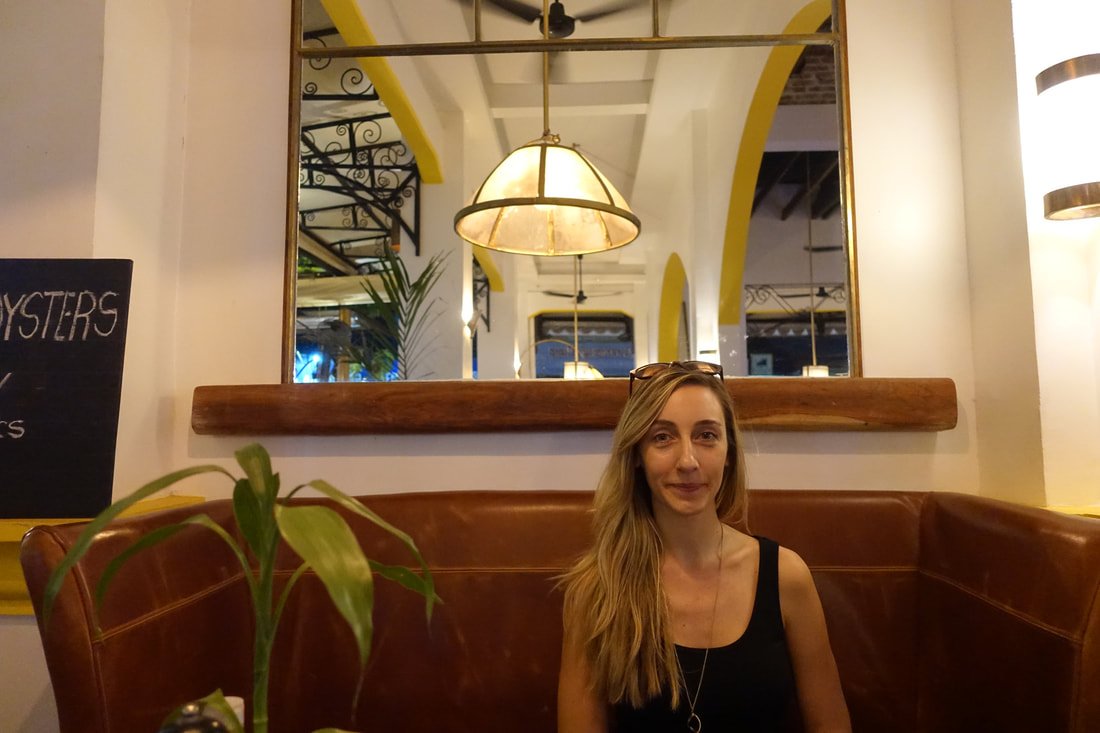
This Asian-French restaurant on 7th Street, very close to Pub Street, stole our hearts with its atmosphere. After a tiring day, we were practically pulled inside by the colonial high ceilings, large yellow chandeliers and wonderful smell of wood-fired pizza. We were not hungry, though, so we had a delicious coffee at a lovely table instead. Le Napoleon, which also serves Khmer dishes, offers a genuinely relaxing and peaceful experience.
| 
|
LADY KHMER KITCHEN
This is a neat, very affordable restaurant we chose for trying lok lak and amok. It is on Sok San Road and is probably one of only two or three places in Cambodia where I would say the service is genuinely good. Lok lak is a salty, delicious beef dish usually served with rice. Amok is traditionally a curry steamed in banana leaves, but when we saw it on the menu we decided to try the chicken coconut amok, and the result was fantastic. A huge, delicious dish arrived inside a real coconut, fragrant with coconut oil. This restaurant is an excellent choice for cleanliness, taste and price, and you can visit it confidently in Siem Reap.


| 
|
ALLEY WAY
This tiny street is immediately below Pub Street. Apparently Pub Street has become rather ordinary in Siem Reap and Alley Way is now the place to try something new. We really did spot some pleasant restaurants and cafés along the way.

| 
|
WHERE TO STAY IN SIEM REAP
Siem Reap hotels range from the cheapest hostels to the most luxurious golf resorts. Accommodation in Siem Reap city centre is generally budget-friendly, with plenty of backpacker hostels and guesthouses. On all our trips, however, we prefer having a private room and bathroom. In Siem Reap, we found exactly what we needed at Angkor Pal Boutique Hotelwhere we stayed. Do not be put off by the words “boutique hotel”: it was really a modest guesthouse. Our room was spotlessly clean and had two three-quarter-size beds, meaning we could throw all our belongings onto one of them =D. The TV had plenty of English channels and, best of all, there was a kettle in the room. While researching hotels in Cambodia, I noticed that some places did not have air conditioning or hot water. The air conditioning in our room worked very well, and we had hot water in the bathroom.

| 
|
The best part of the hotel was the small pool in the back garden. It was tiny but looked lovely, with comfortable sun loungers where we could relax around sunset and shake off the day’s tiredness.

Breakfast was included in the price (100 TL per night in January 2018), and forget the omelettes and tea: there was fresh baguette. Anyone who has travelled in Asia knows how difficult bread can be, but Cambodia was once a French colony, so baguettes and similar types of white bread are easy to find. Everyone at reception was also wonderfully friendly and helped us with everything, from hiring a tuk-tuk for Angkor Wat and giving us New Year’s advice to even helping us buy a bus ticket from Siem Reap to Phnom Penh a bus ticket from Siem Reap to Phnom Penh. We only appreciated how valuable that was after staying in other hotels in Cambodia.

The dirt lane leading to our hotel. | 
Our hotel breakfast. |
HOW TO GET TO SIEM REAP
If you live in Asia like us, or are travelling from somewhere else in Asia, you may prefer to fly to Siem Reap, as AirAsia flights there are usually very affordable. There are international flights to Siem Reap international flights to Siem Reap from almost every major airport in Asia and even from some Western countries.

| 
|
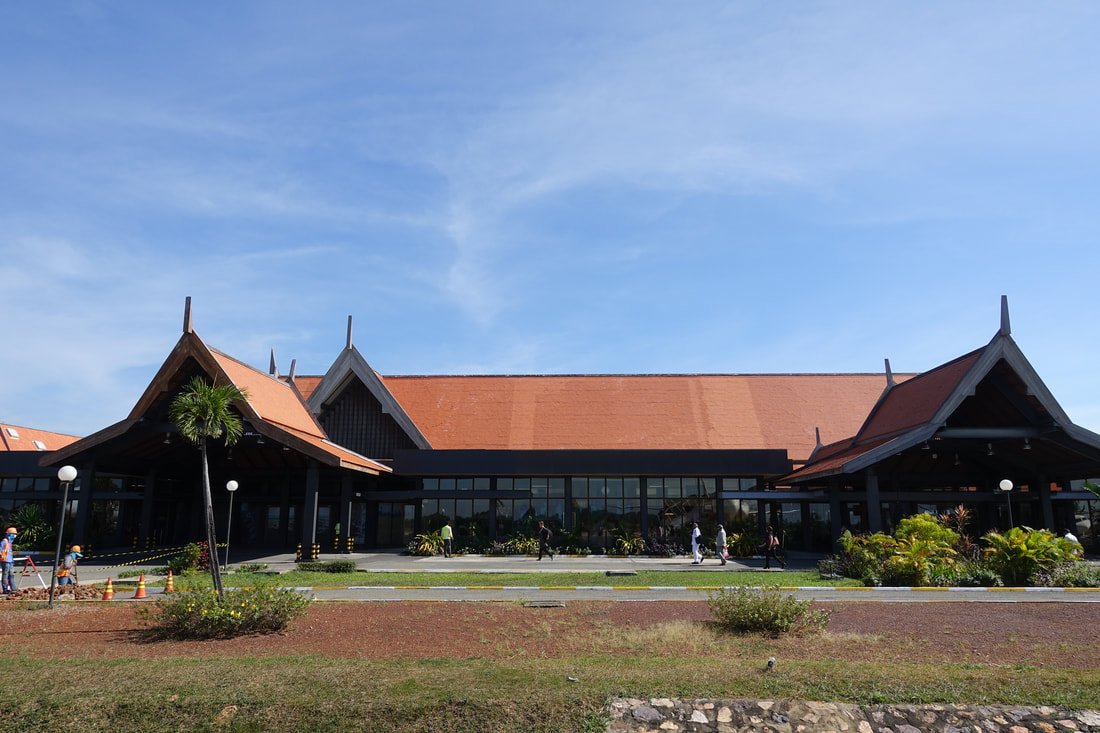
We chose to fly from Kuala Lumpur to Siem Reap. A one-way AirAsia ticket cost around 120 TL per person and the flight took two and a half hours. Siem Reap Airport is 7 km from the city centre and, as mentioned earlier, your hotel will usually send a tuk-tuk for you. Otherwise, with some firm bargaining, you can get from the airport to the city for around 10 dollars.
| 
|
Turkish citizens need a Cambodian visa. You can apply for one online in advance, but it costs 35 dollars, while a visa on arrival at the airport costs 30 dollars. You only need to bring one passport photo. After landing, the forms are free at the airport: fill one in, hand it in with your photograph at the visa desk, then collect your passport with the visa from the other side of the desk, rather like Starbucks. It took us 15 minutes to get our Cambodian visa on arrival at the airport.
From Thailand, Vietnam and Laos, you can also travel to Cambodia by bus but we had not tried it at the time. We had read on many blogs that travelling by bus in Cambodia could be a slightly dangerous option. Still, we decided to travel by bus from Siem Reap to Phnom Penh and travelled with Giant Ibis, said to be the best company for this route. Nothing went wrong, and the winding road through the villages was very enjoyable. If you travel this route in the morning, we recommend sitting on the left side of the bus: you will avoid the sun and the views are wonderful. On our trips around Asia, we prefer buying our bus tickets from busonlineticket or the easybook website and you can use these sites with confidence if necessary.
If You Have Upcoming Travel Plans...
When you make a purchase by clicking our links, we get to earn a small commission but you still pay the same price. So, it's a win-win for everyone!

Book hotels via Booking.com | 
Find Cheap Flights via Skyscanner | 
Get a Travel Insurance via World Nomads | 
Make International Money Transfer via Wise |

Book Tours & Attractions via Getyourguide | 
Book a Cruise | 
Book Bus/Ferry/Train/Transfer via 12goAsia | 
Find free accommodation in exchange for petsitting |